

Rocket House at 25

It’s hard to believe—to accept—that Rocket House was released 25 years ago on June 5, 2001. Those of us who bought the album in 2001 or attended a RH tour concert are—how to say this?—old! Most are probably GenXers or Millennials, with a few Boomers in the mix. Chris Whitley, a Boomer himself, would have been 66 in August. Pardon the cliche but … how time flies.
Nonetheless, the sonics of Rocket House are timeless: it’s an album that, whether released four decades ago or four days ago, would have appealed to at least a few segments of the listening public. Matt Halverson described those sonics especially well:
Chris Whitley has thrown blues and trip-hop in the blender to give us Rocket House. …. A traditional blues guitarist with six indie albums under his belt, Whitley has clearly decided to explore the lengths to which he can stretch his ability. While on previous outings, his guitar was the driving force behind his music, here it’s merely one layer of a dense sonic package that includes synthesizers, bongos, turntables and drum machines.
Add the plink of a spacey banjo to that mix, and you’ve got the instrumental lineup for the dizzying “Chain.” Fuzzy guitar loops swoop by like low-flying planes while a start-stop jazz drum drives the languid trip forward. …. At times it sounds like Whitley has stuffed his guitar into an amp and pulled it out backward. Wah-wahing riffs zip and zing back and forth until it’s difficult to tell which way they’re traveling. ….
Even when he settles into traditional stripped-down acoustic blues, Whitley finds a way to inject a subtle collection of not-so-traditional computer burps and flutters on "Solid Iron Heart." But he's at his best when he lets the B.B. in him [sic - there was exactly zero B.B. King in Chris Whitley!] take a step back and make room for his inner-Tricky.
…[T]rip hop and blues? It may not sound like the most likely of pairings, but on Rocket House, Chris Whitley proves that mixing seemingly different tastes can create an interesting new flavor.1
Although Whitley employed lots of music-tech to create Rocket House, he described the project as ‘organic’ and himself as ‘primitive’2; during an interview at WXPN, he said that Rocket House is really pragmatic and centered in the country blues tradition:
Below I highlight Fargo’s Rocket House Bonus CD, provide excerpts of some reviews, and compile A/V re the full-band RH tour. I also include some info about individual tracks gleaned as I reread dozens of RH articles.
Releases
ATO/UlfTone/Rubber Records/et al: Although Rocket House was an ATO project from the get-go and was released in the US exclusively by ATO, it was licensed to UlfTone (Germany), Fargo (France), and Rubber Records (Australia). The Fargo release stands out because, in addition to the Rocket House released by all the labels, Fargo also offered Rocket House (bonus édition limitée 8 titres inédits), which included radio edits, live performances, and acoustic versions of some songs. [Tbh, I listen to this bonus CD frequently but the main CD almost never … except for “To Joy” and “Chain” … well, also “Say Goodbye” and “Something Shines” … and “Shadowland” ….] As the listing on discogs.com indicates, this is a bit of a rarity, thus selling for $50 - $100.


Reviews
Critics embraced Whitley’s ‘new’ sound. Many viewed Rocket House as relaunching his career, as being a “breakthrough” album that would gain him a larger audience. Below are excerpts from representative reviews. You can read the full review by clicking the link and access more reviews on my Box account.
All Music review: Anyone who has the balls to combine turntable scratching and trip-hop beats with banjo playing on the same song—and make it work—as Chris Whitley does on the Middle Eastern-tinged "To Joy (Revolution of the Innocents)" deserves a collective bow-down to. This unorthodox, textured, and electronic-oriented album opener to Whitley's seventh studio effort, Rocket House, sets the stage for one of the best collections to drop in 2001.
Blue Rhythm: Dobro-specialist Chris Whitley counts among the most innovative singer/songwriters that come from the Blues but are not pulled under by it. He proves this once again with “Rocket House”: a pulsating manifest of traditional roots-elements and urban loops, beats and scratches. “Yes, it is my best album so far. An album that I’ve been trying to make for the past 20 years but never knew how. …. It took a while until it started moving but then everything was flowing freely. Everything kinda came together. It was real fun, there was a kind of magic in the air!”
Whitley … has always had a crush on computer sounds. On “Dirt Floor”, he serviced the Kraftwerk-tune “The Model” as a banjo-version. Where is this passion coming from. The trail leads to Belgium. In the eighties, the Texan was thrown into the European Techno- and EBM-mecca, where he played a while with different cover bands.
Billboard cover article: As wary of corny traditionalism as he is of trendy futurism, Whitley has always followed the spirit rather than the letter of his heroic exemplars from Robert Johnson to Bob Dylan. Yet the digital beats and electronic atmospherics of Rocket House still take on a sepia tone, so that the new single, “To Joy (Revolution of the Innocents),” seems simultaneously down-home and downtown — much like the man himself.
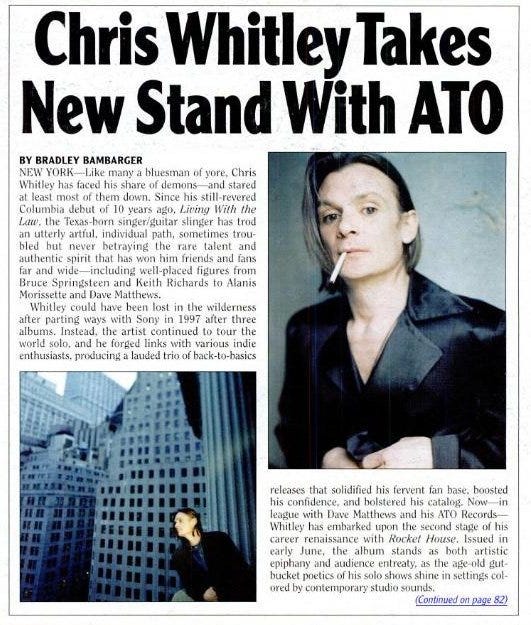
Exclaim!: This is a producer's album. Or more like an over-producer's album. Rocket House isn't so much an album of songs as it is arranged electronic abstractions with songs conveniently matched in between often very successful studio machination episodes. All this is quite exciting and enjoyable for, oh, about five minutes. [I had to include one pan ….]
Creative Loafing: Listening to this disc is like walking into a freaky dream -- unsettling, illuminating, mind-bending. …. Rocket House further certifies Whitley as one of the most innovative, shape-shifting, and challenging figures in popular music -- in short, one of the few artists in rock who matters. The album is another stylistic breakthrough in a career marked by them. Working with producer Tony Mangurian (Luscious Jackson), Whitley has infused his droney future blues with a sublime mix of programming and loops, but in a fresh, well-balance manner that still manages to incorporate his gritty work on dobro, banjo and slide.
NPR:
Popdose: Through a seamless blend of his haunted blues with modern production touches like samples, programmed beats, and turntables, he managed to have his cake and eat it too, broadening and commercializing his sound without sacrificing integrity in the bargain. The first single, “Radar”, is a perfect example — you’ve got Bruce Hornsby on keyboards, Dave Matthews doing background vocals, and all manner of production gewgaws, but the song evokes the same sepia-toned vistas of all Whitley’s best work.
Pure Music: Sometimes when the music I have on gets unusually interesting, I catch myself gazing toward the CD player beside my work table, as if I believe the song I'm hearing is actually there. About a minute and a half into the third cut on Chris Whitley’s new album, Rocket House, I realized I was staring at the player, trying to see what made the song sound so good.
ATO promo: Few moments are as exciting as the one where it becomes undeniably clear that an artist has made his breakthrough. Rocket House is that moment for Chris Whitley. After a decade as one of rock’s most beloved cult icons, Whitley has reinvented himself from the bottom up. Rocket House, Whitley’s seventh album and first full-fledged studio recording in five years, finds his characteristic smoky-voiced blues-rock dirges invigorated by trip-hop beats, lushly layered arrangements and a soulful vocal style that invokes Al Green as much as Howlin’ Wolf.
Audio/Video
The audio and video compiled below focus on the full-band RH tour. Because that tour lasted less than two weeks (an outcome I explain in a forthcoming essay), we don’t have a lot of material, but what we have is very good. If you’re interested in Chris Whitley’s preview of RH songs during his Spring 2001 European tour or his Fall 2001 solo RH tour, check out the Chris Whitley Collection on the Live Music Archive.
at The Bowery (NYC, 2001-07-10): A short playlist of two videos (“To Joy” and one of my all-time favorites “Radar”. We also have a partial bootleg capturing four additional songs. Also check out the short interview by DJ Andy Anderson and Ann Powers’ NY Times review of this show, “Blues with a Scratch”.
at The Fox Theater (Boulder, CO, 2001-07-12): Thanks to Steve Antonuccio for sharing this professional recording.
At the Great American Music Hall (San Francisco, 2001-07-18): Thanks to Hiroshi Suda.
Bootlegs: I’ve uploaded all the bootlegs we currently have, including …
Bits about Songs
Chain: I love Creative Loafing’s description of Trixie’s vocal on this track: “On Chain, a computer-treated vocal refrain by Whitley’s 14-year-old daughter Trixie courses through the song like dripping paint.”
Vertical Desert & Solid Iron Heart: “In the last four or five years I’ve become a lot less inspired by the singer-songwriter thing,” Whitley said by phone from his West Village apartment. “It’s still important to me; I still listen to Dylan. But I feel like in narrative songwriting that there are so many amazing songs, that there’s got to be some sort of new form. I try to do that [get beyond narrative] with a couple of songs on this record, ‘Vertical Desert’ and ‘Solid Iron Heart. .... I approached them as if I didn’t know what I was writing about. I wanted them to be slightly free or surrealist, where there wasn’t a specific idea in mind but rather something deeper. I get tired of songs about things; they’re the least challenging. I want to get some other kind of resonance that is broader and deeper than narrative.”3
Solid Iron Heart: Ulf Zick, owner of UlfTone, tour promoter/manager of European tours, recalled that ‘Solid Iron Heart’ “was dedicated to Peter Burkhart, the owner of the then best club in Europe, who gave Chris a solid iron heart after one of his performances.”4 Thanks to Hiroshi Suda, I learned that this track was listed as “Mechanical Ballet” on the RH advance CD. Although Chris changed the song’s title, “mechanical ballet” appears in its lyrics:
Down at the mechanical ballet
Where the parted thighs belong
Now you are farther away
You’re farther away than anyone
In another interview, Chris stated that “I wrote the song ‘Solid Iron Heart’ shortly beforehand and played it live with DJ Logic in one take. That’s what I call organic. “
From a Photograph: Derek Simmonsen lauds this track as “[o]ne of the more remarkable tracks …, which Mr. Whitley and DJ Logic did in one take, having never played the song before.”
Chris’s brother Dan described the IRL inspiration for this one, at least for the “baby’s got a gun” lyric:
Well, the thing which actually prompted that line is an actual photo/picture which is in a restaurant in NYC [later identified as Shopsin’s, a NYC institution], in the photograph is Chris’ then ex-girlfriend holding a pistol pointed sorta towards the camera, it’s a framed black and white ...they were breaking up at the time. Anyway, she was sorta making a statement when they split by giving this picture to the restaurant owner to put up on the wall so everyone could see it, sorta funny but sad, Chris had a hard time staying faithful, he was a total free spirit. Anyway, this deli/restaurant owner was like one of the family and his lil restaurant on the corner (off Morton St at the time) was a special spot since both I and Chris worked there as teenagers and it was like a home away from home whenever either one of us were in the city. So that’s basically how that came about.
I provided the infamous photo and Laura Wiley’s perspective on this anecdote in an earlier post:

To Joy: Somewhere (haven’t tracked down the source) Chris says that he was thinking about the joy of beginning his relationship with Susann. Also possibly a reference to the Bergmann movie (1950) of the same name.
Serve You: In live sets, Chris often introduced this song as being “for Trixie.” Laura Wiley provided the IRL story about the origin of “Serve You”:
The root of “Serve You”: Chris, Andrew Rosen (Goat) and maybe Dougie were eating lunch at Shopsin’s one day. Evie Shopsin places 3 huge serving bowls on the table, one in front of each of them. Andrew looks lovingly at Evie and says, “One day I will serve you.” True story!!
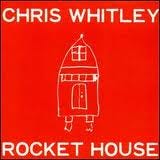
Rocket House: As you probably know, the album title and the track were inspired by Trixie’s drawing, which is featured on the CD cover:
I’m working on a long essay tentatively titled “Rocket House: A Tragedy in Three Acts” that examines how Whitley blew the opportunity that working with Dave Matthews’ ATO record label provided. But that ‘own goal’ does not diminish what Whitley achieved with this album. I hope that the material compiled above reminded you of that achievement.
Related post:

Matt Halverson, “Burning Down the House”, https://musiccritic.com/rock/whitley_rockethouse.htm
Matt Blackett, “Future Primitive”, Guitar Player, November 2001
See also Derek Simmonsen, “Whitley ‘Rockets’ to Space in CD”, The Washington Times (Washington, DC), July 7, 2001
Ulf also recalled that “The album was mixed at Green Street Studios NYC, a legendary place where mostly Hip-Hop history was made. I have DAT’s somewhere with rough mixes as well from that period that we used to create initial hype with distributors and media.” If those DATs include “rough mixes” of RH, wouldn’t we love to hear those!
I can't remember if I bought it the day it was released or not, but I know for a fact it was within the first week. For me, it was his most powerful statement since his debut, and it still sounds as fresh 25 years (!!!) on.
Thanks for this thorough and monumental post.
As I told you, this was the record that made me a CW fan. I was driving into Nashville listening to RH and that same day bought myself a dobro and went to it!